
Non-Renewal Notice? Here Are Your California Home Insurance Options
Nick Fugazzi
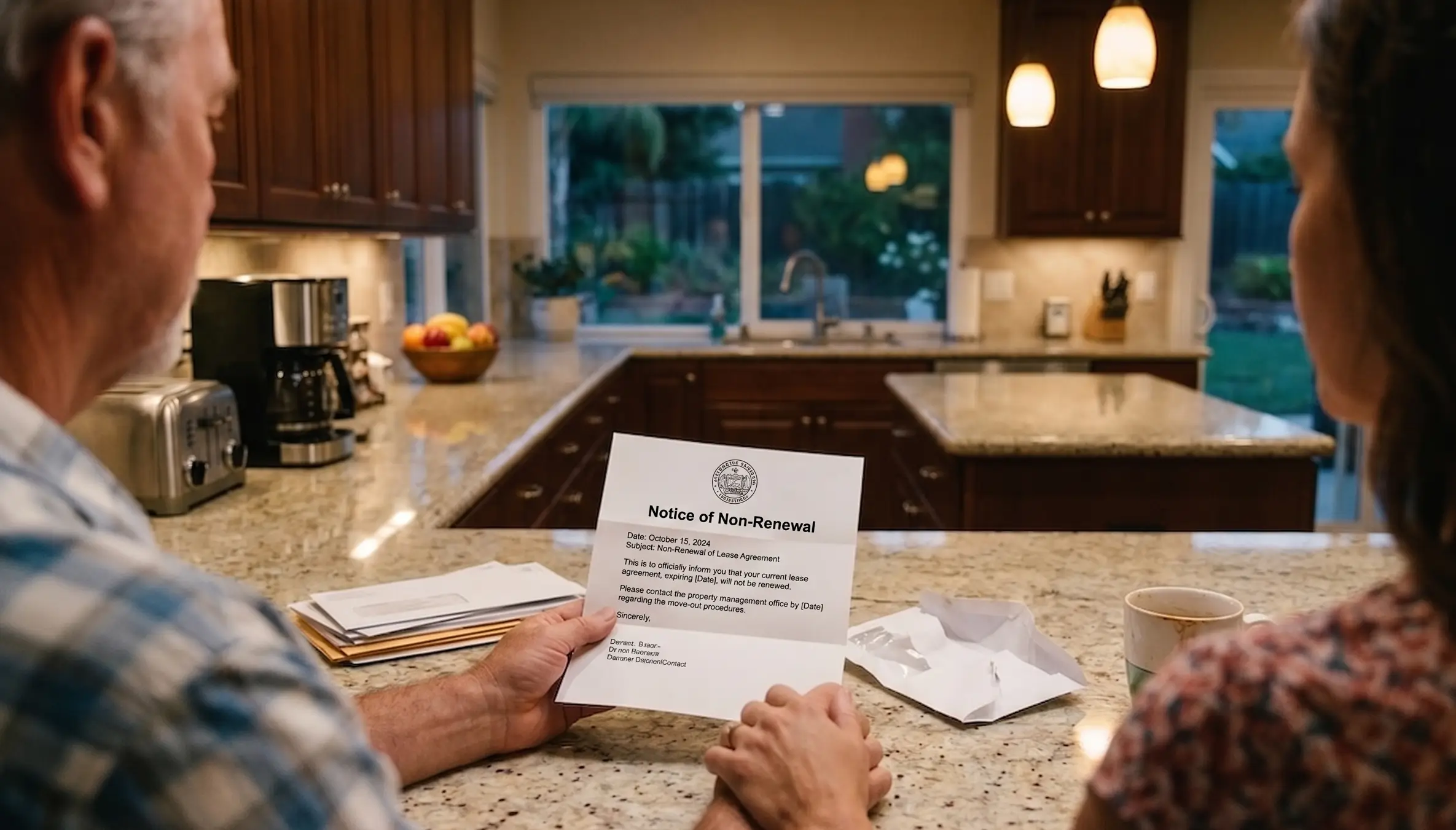
You see the carrier’s logo on the envelope and you already know. Ten years with them. Maybe fifteen. The premium kept creeping up cycle after cycle, but the relationship felt stable enough. Then you open it, read “notice of non-renewal,” and something drops in your stomach.
Then come the questions, fast. Will the mortgage company find out? How long do you actually have? Did you do something wrong? Was it that one claim from 2019? Are you headed for the FAIR Plan? Is the FAIR Plan really as bad as people say it is?
Take a breath. The next 75 days really are manageable if you work through them in order. And the California insurance market in 2026 is in a better spot for shoppers than it was twelve months ago. We’re not saying that to soft-sell you on anything; it’s just where the data is actually pointing. So here’s what to do, and what’s worth knowing about why this is happening to so many homeowners who didn’t do anything wrong.
What Non-Renewal Actually Means (And What It Doesn’t)
Non-renewal is not the same as cancellation, and the distinction matters more than it sounds like it should. A cancellation ends a policy mid-term, and California law only allows it for a short list of reasons: nonpayment, fraud, or a material change to the property. A non-renewal is different. The carrier is letting your existing policy ride out the rest of its term, then declining to write you a new one for the next.
California Insurance Code Section 678 requires your carrier to send written notice at least 75 days before the policy expiration date. That notice has to state the reason, list a phone number for the carrier’s consumer-inquiry line, and tell you the California Department of Insurance can review the decision. If the carrier didn’t give you a full 75 days, your existing policy stays in force, unchanged, for 75 days from the actual mail date of the notice. That’s your protection, written into the code.
One more protection worth checking before you do anything else. Under Insurance Code 675.1, insurers cannot non-renew residential policies for one year in ZIP codes that fall within or adjacent to a declared wildfire disaster area. California has had a few of those declarations recently: the Pack Fire (December 2025), the TCU Lightning Complex Fire (September 2025), and the Franklin Fire (June 2025). The CDI maintains a ZIP-code lookup tool for active moratorium bulletins. If your address sits inside one and your non-renewal cited wildfire risk, the notice may not actually be enforceable. The lookup takes about a minute. Do it first.
And the bigger thing most homeowners need to hear: a non-renewal in 2026 is almost never a verdict on you personally. Carriers are pulling back from entire ZIP codes and risk profiles using forward-looking models, not your payment history or how good a customer you’ve been. Plenty of homeowners with clean records and zero claims have gotten non-renewal letters in the last two years. This is a market dynamic, not a personal one.
Why This Is Happening, Briefly
California’s insurance market has been re-pricing wildfire risk since 2022, and the math finally caught up to the regulations. Under Proposition 103, the 1988 voter-approved law that still governs how rates get set in this state, carriers historically had to price policies using only backward-looking loss data. That meant they couldn’t fully account for the catastrophic wildfire losses California has racked up over the last decade. State Farm, Allstate, Farmers, and several smaller carriers responded the way you’d expect: they limited or paused new business and started trimming their existing books. Fourteen of the twenty most destructive wildfires in California history occurred in just the last ten years. The Los Angeles fires in January 2025 cost several large carriers more than a billion dollars each, on their own.
So if your carrier dropped your policy, you got caught in a structural correction. You weren’t singled out. The reason that distinction matters here is practical: the same forces that drove the non-renewal wave are now driving the changes that are making coverage easier to find again. More on that shortly.
Your Real Next Steps
Five steps, in order. Most homeowners can finish all five inside the 75-day window with time to spare.
#1. Read the notice and put two dates on your calendar.
Find the policy expiration date and the date the notice was actually mailed. The first is your hard deadline. The second tells you whether the carrier complied with the 75-day rule. While you’re in there, look for the reason code. It’s usually one or two lines, and it tells you whether your non-renewal is about wildfire-zone exposure, the home itself (roof age, defensible space, vents), or something else entirely. That reason will shape every conversation you have next.
#2. Loop In Your Mortgage Servicer Early
Lenders require continuous coverage, and if your policy lapses, they have the right to buy a force-placed policy on your behalf. Force-placed policies are expensive, and they protect only the lender’s interest — not your belongings, not your liability, and not your living expenses if something goes wrong. A short call or email letting your servicer know you’re working on replacement coverage usually keeps everyone calm. They deal with this all the time now.
#3 Call an Independent Agent
Call an independent agent before you start shopping carriers one at a time. This is probably the highest-leverage move you can make inside the 75-day window. An independent agent can quote across a portfolio of carriers in a single conversation: admitted carriers still writing in California, surplus-lines markets that are picking up risks the admitted carriers won’t touch, and the FAIR Plan as a backstop if it ends up being needed. A captive agent at any one carrier can only tell you whether that carrier will write you. An independent agent can tell you what your actual options look like.
#4 Gather Documentation
Pull together documentation that strengthens your application. Carriers writing in California right now look closely at property-specific risk factors. The things that genuinely move the needle: roof age and material (Class A roofing helps), defensible space work around the home, ember-resistant vents, electrical or plumbing upgrades, and any community-level wildfire mitigation if your neighborhood has done that work. If your home qualifies for the Wildfire Prepared Home designation through IBHS, that’s a real underwriting credit. Photographs, receipts, inspection reports — they all help. The goal is to show your home as it actually is, not let a ZIP-code-level model decide what it must be.
#5 Get Quotes On All Programs
Get quotes across the whole landscape, including the new programs. A lot of homeowners don’t realize there are now four tiers of options.
The first is admitted carriers: the household names, regulated by the state and backed by the California Insurance Guarantee Association.
The second is the surplus-lines market — non-admitted, more flexible underwriting, broader risk appetite. New surplus-lines homeowners business hit roughly 320,000 policies in 2025, up from about 50,000 in 2023, which tells you how real this market has gotten.
The third is the new Sustainable Insurance Strategy programs from carriers like Mercury, built specifically to write policies in higher-risk areas. And the fourth is the FAIR Plan paired with a Difference in Conditions (DIC) wraparound policy, the fallback if nothing else fits.
That last option, FAIR Plan plus DIC, is worth being clear-eyed about. The FAIR Plan is California’s insurer of last resort. It covers fire, smoke, lightning, and a handful of other named perils, but it doesn’t cover water damage, theft, or liability. To get something resembling a real homeowners policy, you pair the FAIR Plan with a DIC policy from a private carrier that fills in the gaps. The combination does work. It also typically costs more than a standalone admitted-carrier policy, and the FAIR Plan’s average premium is now around $3,200 a year, before you add the DIC layer on top of that. Treat it as a bridge, not a destination.
The good news for a lot of homeowners coming off a non-renewal in 2026: the FAIR Plan is no longer the only fallback.
Mercury Insurance has filed and received approval for a new homeowners program built specifically for Californians in higher-risk areas, including, in many cases, the same homes that would have been routed straight to the FAIR Plan a year or two ago. As an independent Mercury agent, at VNGO we can quote you on this Mercury program alongside the rest of the market in a single conversation. It’s the kind of side-by-side comparison that’s genuinely hard to put together on your own.
The Market Is Actually Moving
Here’s a piece of the story that doesn’t really make the headlines, because “carriers are quietly returning” gets nowhere near the clicks “carriers are leaving” does. Insurance Commissioner Ricardo Lara’s Sustainable Insurance Strategy is the most significant overhaul of California insurance regulation in something like 35 years. It’s been working its way through implementation for two years now, and the results are starting to show up in actual policy filings.
The deal underneath it is simple. In exchange for being allowed to use forward-looking catastrophe models when pricing, carriers have to commit to writing more policies in the parts of the state they’d been pulling back from. Seven major carriers have signed on so far. Mercury, CSAA, Farmers, USAA, Pacific Specialty, and California Casualty were the first wave. On April 24, 2026, Travelers — a top-tier national carrier with $49 billion in 2025 revenue — announced it’s joining the program too, with explicit plans to expand availability in wildfire-exposed communities.
The commitments are specific, not vague. Mercury alone has agreed to write more than 38,000 new California policies over the long haul, with roughly 6,000 of those in the next two years and a meaningful slice coming from FAIR Plan depopulation. Farmers eliminated its previous cap of 9,500 new policies per month. CSAA has already written more than 18,000 new policies in high-hazard areas, beyond what was required of it. None of this fixes the market overnight. Rates are still climbing as carriers re-price for the risk they’re carrying, and statewide premiums are projected to rise roughly 16 percent by the end of 2026. But the doors that were closed in 2024 are opening back up, and the homeowner shopping for coverage in May 2026 has more options than the homeowner who shopped in May 2025.
If your home sits in one of the Fire Hazard Severity Zones (the high or very high zones that show up in red on California’s CAL FIRE map across so much of the Conejo Valley and the hillsides around Westlake Village, Thousand Oaks, Agoura Hills, Calabasas, and Oak Park), this is the part that matters most. Being in an FHSZ is no longer a verdict on your insurability. Several of these new programs are built precisely to write policies in those zones. It’s worth knowing your designation either way; the CAL FIRE FHSZ viewer at osfm.fire.ca.gov lets you look up any address.
Sixty Days From Now
Picture your kitchen counter sixty days from now. The non-renewal letter is filed away somewhere. Your mortgage servicer has the new policy on file. You’ve talked through the options with someone who actually works the California market, and you know exactly why you ended up where you did. The 75 days that felt so urgent on day one turned out to be enough time to do it properly.
That’s the realistic version of where most homeowners land, as long as they start early and shop the whole landscape. The California market is genuinely difficult right now, and the rate increases are real. But “difficult” and “nowhere to go” are not the same thing, and the gap between them has gotten meaningfully narrower in the last twelve months.
If you’d like a hand walking through what’s actually available for your home, across the admitted markets, surplus lines, the newer Mercury options, and the FAIR Plan if that ends up being the right fallback, VNGO is here. We’ll pull quotes across the options so you can see the comparison side by side. No pressure. The point is that you do have a real choice in front of you, not a forced one.
Sources
California Department of Insurance, Mercury Insurance and CSAA Expand Homeowners Coverage Under Commissioner Lara’s Sustainable Insurance Strategy (December 20, 2025): https://www.insurance.ca.gov/0400-news/0102-alerts/2025/Mercury-Insurance-and-CSAA-Expand-Homeow.cfm
California Department of Insurance, Mandatory One Year Moratorium on Non-Renewals (current bulletins including Pack Fire, TCU Lightning Complex, and Franklin Fire declarations): https://www.insurance.ca.gov/01-consumers/140-catastrophes/MandatoryOneYearMoratoriumNonRenewals.cfm
Insurance Journal, Travelers to Expand Homeowners Insurance Offering in California (April 27, 2026): https://www.insurancejournal.com/news/west/2026/04/27/867393.htm
United Policyholders, Dropped by your home Insurer? Where to go for help in California: https://uphelp.org/buying-tips/dropped-by-your-insurer-where-to-go-for-help-in-california/
Bankrate, California FAIR Plan insurance: What it is and how it works (Natalie Todoroff, updated July 2025): https://www.bankrate.com/insurance/homeowners-insurance/california-fair-plan/
California Office of the State Fire Marshal (CAL FIRE), Fire Hazard Severity Zones (FHSZ viewer): https://osfm.fire.ca.gov/what-we-do/community-wildfire-preparedness-and-mitigation/fire-hazard-severity-zones
California Insurance Code Section 678 (75-day non-renewal notice requirement), via FindLaw: https://codes.findlaw.com/ca/insurance-code/ins-sect-678/